

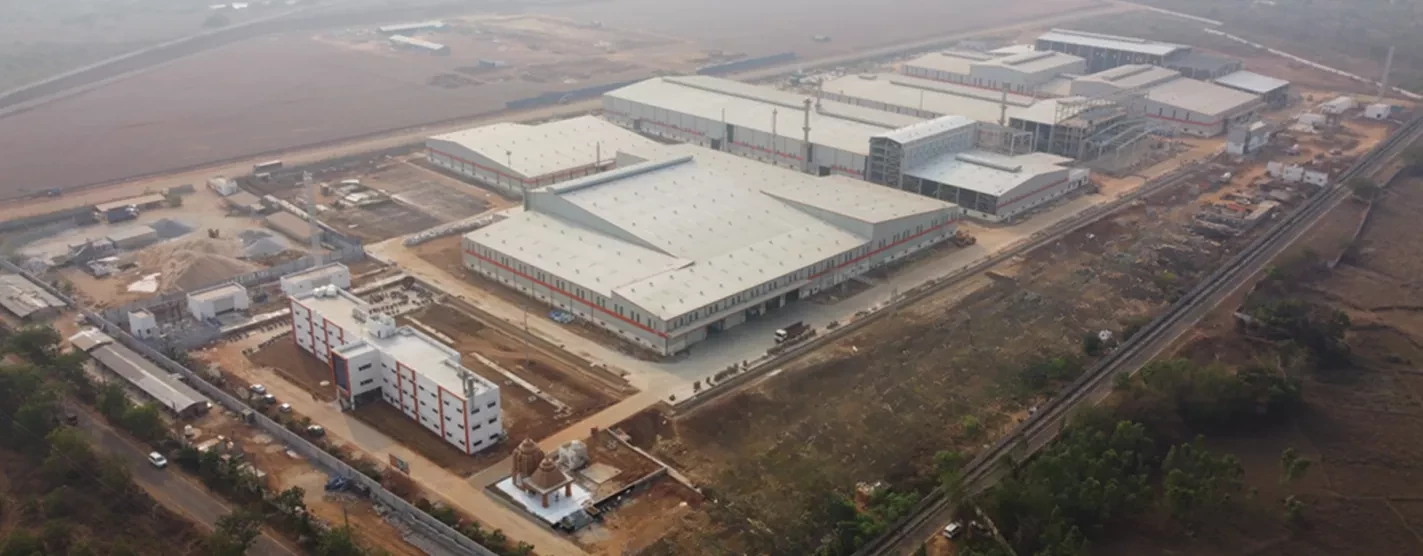
Basic monolithics from the Calderys plant in Odisha (CAPES)
Application range
Basic gunning masses:
-
Ruhrstahl-Heraeus (R-H) gunning: For hot repair of degassing unit snorkels
-
Electric Arc Furnace (EAF) gunning: For hotspots, oxy-fuel jet areas, and slag doors
-
Energy Optimizing Furnace (EOF) gunning: For tuyere-stadium zones experiencing severe wear
-
Ladle gunning: For slag and metal zone repair during secondary steelmaking
-
EAF hearth DVM: Sacrificial layer between liquid hot metal-slag and EAF hearth bricks
-
Tundish DVM: Working lining for continuous casting tundish
Dry vibratory masses (DVM):
-
EAF hearth DVM: Sacrificial layer between liquid hot metal-slag and EAF hearth bricks
-
Tundish DVM: Working lining for continuous casting tundish
Engineered performance characteristics
Basic gunning masses:
-
Optimized grain size distribution for enhanced adhesion and minimal rebound loss
-
Application-specific raw material selection and binder systems
-
Premium dead burned magnesia (DBM) with high CaO/SiO₂ ratio to prevent low-melting phase formation
-
Excellent sinterability and corrosion resistance
-
Superior stickability for effective hot repair applications
Tundish DVM:
-
High-purity dense DBM and dunite with high forsterite phase for excellent slag corrosion resistance
-
Composite binder system for good bond strength at different temperatures
-
Due to hybrid binder system tundish DVM has higher intermediate strength above 1,000°C
-
Varied magnesia content (65-90% MgO) based on specific process requirements
-
Engineered to handle uneven temperature gradients and thermal shock, particularly at free board areas
EAF Hearth DVM :
-
Forms calcium ferrite compounds above 1,300°C, acting as sintering aids
-
Enhanced densification of periclase grains for superior structural integrity
-
Improved hydration resistance through controlled chemical composition
-
High packing density and excellent sinterability
Manufacturing excellence:
CAPES features a dedicated production line for basic monolithic, engineered with global expertise, incorporating:
-
In-house crushing and grinding to minimize raw material hydration and ensure consistent particle size distribution
-
Automated batching system for precise ingredients dosing with complete traceability
-
Specialized mixing equipment optimized for basic monolithic formulations
-
Flexible packaging solutions (25 kg bags and jumbo bags)
This integrated manufacturing approach ensures every batch meets stringent quality standards while supporting the production capacity required for India's expanding steel industry.
Technical advantages of basic monolithics at CAPES
Raw material quality: Premium raw materials sourced through Calderys' global network ensure consistent performance. The formulations utilize high-grade magnesia with optimized CaO/SiO₂ ratios to prevent formation of low-melting phases such as monticellite and merwinite, thereby reducing lining wear.
Application-specific formulations: Each gunning mass variant is engineered with specific bonding systems (phosphate, silicate, or sulphate-bonded) selected based on the required curing mechanism and operating conditions. The formulations address distinct performance requirements across different furnace types and wear mechanisms.
Proven performance metrics:
Basic gunning masses:
-
EOF gunning: 8-12 heats life with <5% rebound loss
-
EAF gunning: 4-6 heats life with controlled rebound
-
R-H gunning: 1-4 heats life with excellent coating adhesion
-
Ladle gunning: 1-2 heats life in slag zone with <10% rebound loss
Dry vibratory masses:
-
Tundish DVM: High intermediate strength (>10 kg/cm²), superior bulk density at operating temperatures, controlled permanent linear change
-
EAF DVM: Successfully achieved 700+ heats in hearth and bank areas, high bulk density and cold crushing strength after firing at 1,550°C
Quality assurance: All products undergo rigorous laboratory testing including:
-
Cold crushing strength (CCS) at 110°C and 1,550°C (gunning), and at curing/operating temperatures (DVM)
-
Modulus of rupture (MOR) evaluation
-
Permanent linear change (PLC) measurement
-
Bulk density verification after firing
-
Slag corrosion testing for tundish DVM
The Calderys plant in Odisha, India (CAPES) can now deliver a full suite of high performance basic monolithics —CALDE® MAG GUN EOF/LADLE/R-H/EAF and CALDE® MAG DRY EAF DVM—produced at the state-of-the-art production line that combines local manufacturing with the global expertise of Calderys in the EMEA region and its HWI brand in the Americas. With a tundish DVM trial in early 2026, CAPES is poised to become a cornerstone for Calderys in India to support the country’s growing steel sector, offering reliable, locally supplied refractory solutions backed by the Group’s worldwide knowledge base.